On this page
The cost of treating wood-boring beetles depends first on whether insects are still active and which wood is affected. Old exit holes in an otherwise stable piece of timber do not justify the same work as fresh emergence in structural framing. A useful quote starts with evidence, then explains which treatment can reach the insect and which repairs remain afterward.
Published chemical prices provide a material benchmark, but they cannot be turned into a national installed treatment rate. A gallon of concentrate is neither a labor allowance nor a measure of how much wood can be treated in every application. The diagnosis, product label, access and condition of the wood establish the job.
Key figures
- $112.45 Nisus Bora-Care one-gallon concentrate, material only
- $434.78 Nisus Bora-Care four-gallon case, material only
- $722.45 Example: concentrate, access, application and cleanup
Fresh evidence matters more than the number of old holes
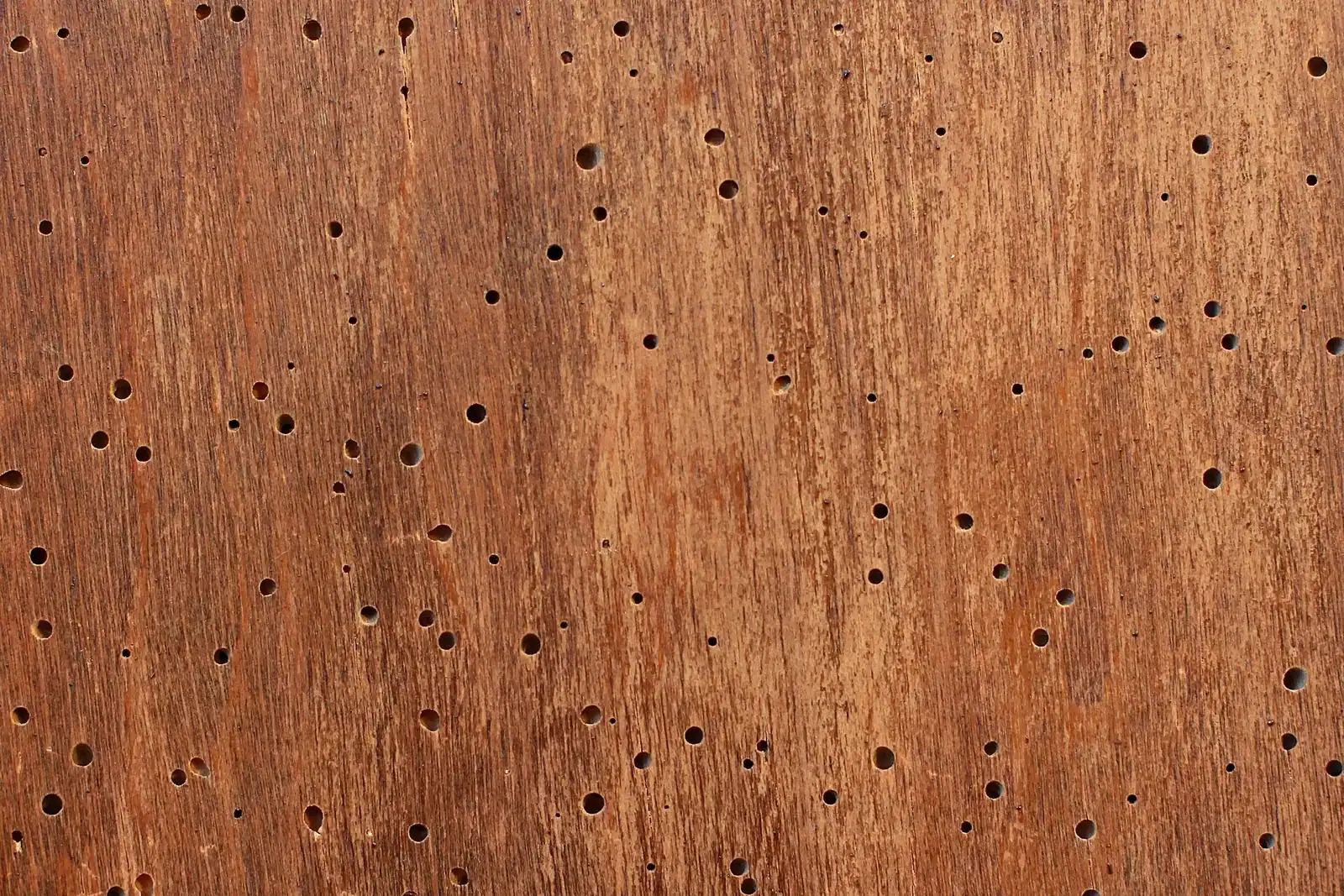
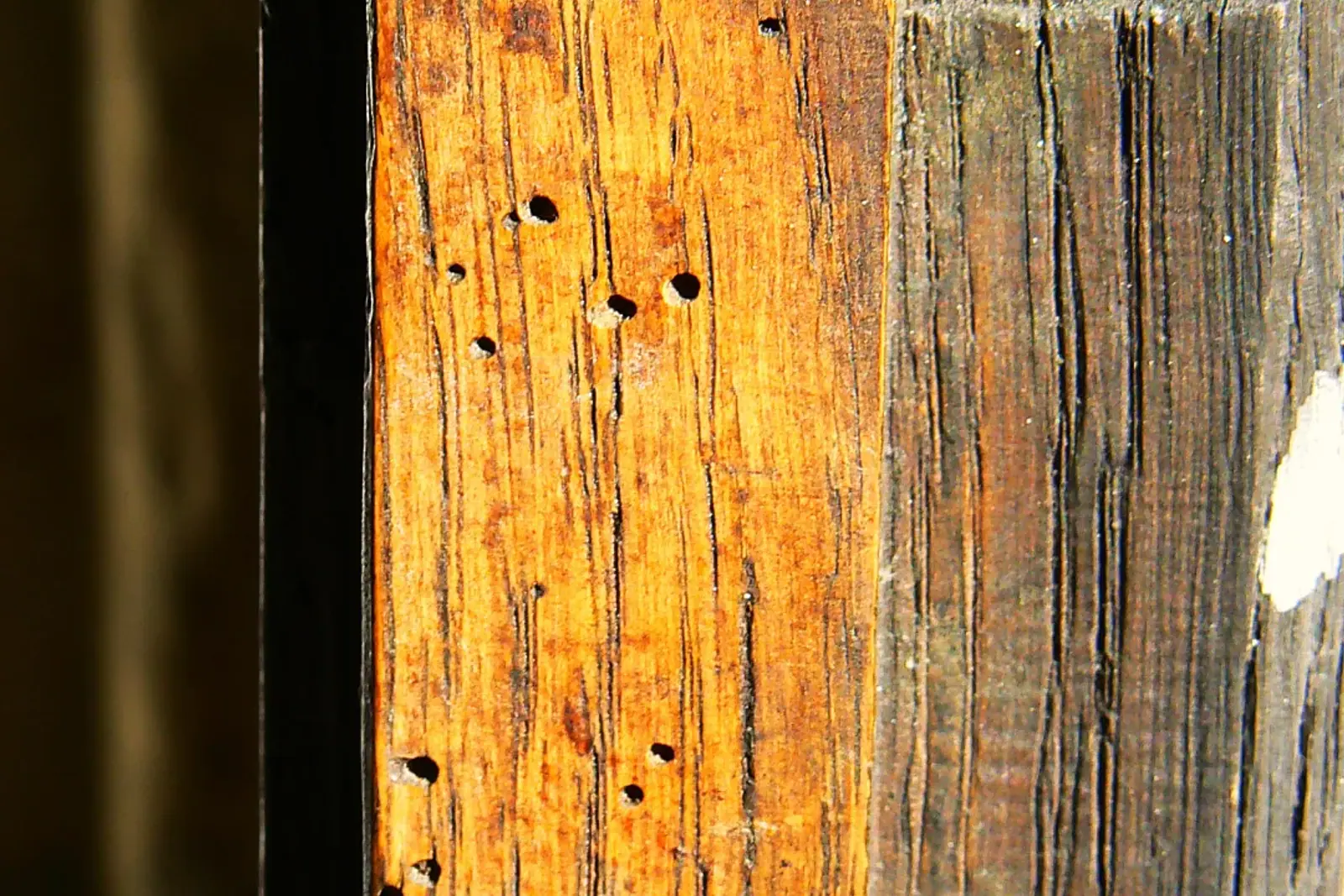
Clemson’s wood-boring beetle guidance distinguishes several insects that leave different-sized holes and favor different wood. These observations help frame an inspection; they are not a household species-identification test. An intact specimen and the affected timber can be more informative than a close-up of one hole.
| Beetle group described by Clemson | Typical exit-hole size | Wood and inspection clue |
|---|---|---|
| Lyctid powderpost beetles | Circular, 1/32–1/16 inch | Hardwood; very fine powder can accompany emergence |
| Anobiid powderpost beetles | Circular, 1/16–1/8 inch | Hardwood or softwood; damp crawl spaces can support activity |
| Bostrichid beetles | Circular, 3/32–9/32 inch | Often associated with recently cut wood |
| Old house borers | Oval, 1/4–3/8 inch | Softwood; different from a tiny circular powderpost hole |
Source: Clemson Extension’s wood-boring beetle factsheet. Published biological descriptions are not current treatment prices or proof that any pictured hole contains a living insect.
Ask the inspector to record fresh powder, newly observed holes, collected insects and affected locations. New powder can deserve investigation, but disturbance can release old debris too. Keep dated photographs and mark the locations being monitored so an unchanged old hole is not counted as new activity on every visit.
Moisture and development explain a long observation window
Clemson describes anobiids as preferring moisture above 14%, with development commonly taking 2–3 years. It describes most lyctid life cycles as 9–12 months. Those are biological examples from its factsheet, not promises that a treatment clears every building within that period.
The practical point is that emergence and damage can have a history. Ask whether the provider found active infestation, a previous infestation or uncertain evidence requiring monitoring. Moisture readings should identify the timber and location measured, rather than offering one vague statement that the whole home is damp.
A plumbing leak, wet crawl space or poorly dried lumber can require correction independently of insect treatment. A quotation that treats wood but leaves the moisture source unresolved may leave another problem in place. The pest identification service guide compares specimen fees when the insect itself is uncertain.
Manufacturer prices establish only the material line
Nisus’ factory store lists Bora-Care concentrate at $112.45 for a 1-gallon container and $434.78 for a 4-gallon case, checked October 2026. Dividing the case price by four gives about $108.70 per gallon. Buying four single gallons totals $449.80, so the case saves $15.02 before shipping and tax.
These are retail product prices, not a recommendation to buy or apply the chemical yourself. The manufacturer identifies wood-boring beetles among the target pests and requires compliance with its label. It also restricts New York sales to licensed pest-control companies. The quantity a contractor uses depends on the diagnosed pest, treatment purpose and label, not on a blanket gallons-per-house rule.
Ask how a proposal prices materials, application labor, access and preparation. A contractor may use another labeled method or obtain a different material price. The factory price is useful for distinguishing a material purchase from an installed service, but it does not set the contractor’s margin or establish a suitable treatment for finished wood.
Access and repair can outweigh the chemical cost
A surface treatment has to reach the wood it is intended to treat. Finishes, covered framing and inaccessible areas change that question. Ask the provider to explain which timber can be reached and what preparation is required. Do not assume a surface application reaches every concealed gallery in finished furniture or enclosed framing.
For an illustrative budget only, one gallon at the published $112.45, assumed access work of $200, application labor of $350 and cleanup of $60 total $722.45. The last three numbers are hypothetical scope lines, not surveyed rates. If another proposal includes access and cleanup, comparing only its material charge with $112.45 would miss most of the work.
Wood replacement and reinforcement are different again. Removing insects does not restore lost strength. Ask whether damaged framing requires a separate assessment and whether floor coverings or wall finishes have to be opened and reinstated. The termite treatment cost guide similarly separates pest treatment from repairing damage, even though the insect and treatment method differ.
Whole-structure treatment requires its own proposal
Western Fumigation says its inspections are free and its fumigation price depends on the pest, structure, size and complexity. It does not publish a single household price in its FAQ. That absence should lead to a measured quote, rather than importing another website’s generic fumigation range.
Request the building volume or other pricing basis, the pest being treated, preparation, accommodation requirements, clearance process and follow-up. A chamber treatment for a removable piece of furniture and a whole-building treatment are different services. Confirm whether furniture transport and return are included if only an item is being treated.
Keep people away from unsafe framing or flooring and obtain a structural assessment when strength is in doubt. Do not improvise household heat treatment or fumigation from a cost guide; operator instructions and the product label control the process.
The sound purchase is the smallest supported job that addresses the active problem and records what remains. If there is no evidence of continuing infestation, the quote should explain why treatment is proposed instead of monitoring. If activity is confirmed, it should identify the affected wood, access and follow-up. A material bottle price cannot answer those questions, but a documented inspection can.
Questions people ask
Do old beetle holes mean treatment is needed now?
Not by themselves. The inspection should assess fresh emergence, powder, specimens and the timber's condition. Old holes remain after an infestation ends.
Is $112.45 the price of treating a house?
No. It is Nisus' displayed price for one gallon of Bora-Care concentrate. Labor, access, preparation, required quantity and repairs are separate.
Should every beetle problem be fumigated?
No. The species, active infestation, wood and access determine the options. A movable item and a widespread structural infestation require different proposals.
Will treatment restore a damaged joist?
No. Eliminating insects does not replace missing wood or restore its strength. Structural repair or reinforcement requires separate assessment and work.
Where these figures come from
- Wood-boring beetles in houses Clemson Cooperative Extension · hgic.clemson.edu
- Bora-Care one-gallon factory price and restrictions Nisus Corporation · store.nisuscorp.com
- Bora-Care four-gallon factory price Nisus Corporation · store.nisuscorp.com
- Fumigation pricing factors and inspection Western Fumigation · westernfumigation.com
Figures last checked October 2026.